Automatic Chicken Coop Doors: What to Check Before You Buy
We earn from qualifying Amazon purchases. We haven't tested these products ourselves. We chose them from specs and what chickens need. How we make money.
An automatic coop door has one job. It shuts your hens in at dusk and lets them out in the morning. If it fails at that job even once, a raccoon can do a lot of damage in a single night.
Our top picks
Paid links. We earn from qualifying Amazon purchases. We chose these from specs and owner feedback, not our own testing. Photos show the type of gear, not the exact product.
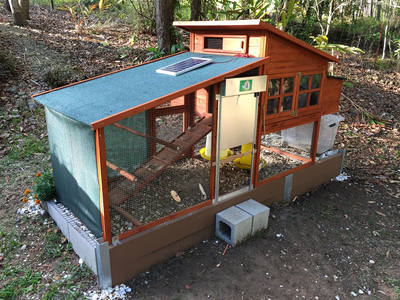 Best for keeping the pop hole you already haveChickenGuard Premium Pop Door OpenerA widely recommended opener that fits onto an existing door.Check price on Amazon →Details ↓Photo: sridgway, CC BY 2.0
- Best for coops with no power nearbyRUN-CHICKEN Door T50A battery-powered aluminum sliding door with app and timer control.Check price on Amazon →Details ↓Photo: sridgway, CC BY 2.0
- Best for buyers worried about predatorsChickenGuard Opener with Self Locking Door KitThe same opener packaged with a self-locking door.Check price on Amazon →Details ↓Photo: sridgway, CC BY 2.0
In this guide
Why the door matters so much
University of Maryland Extension puts it plainly: the highest risk time for backyard poultry is night. Its advice is just as short. Lock birds up during the night. UF/IFAS Extension calls nighttime lockup one of the most effective ways to protect a flock. Raccoons, coyotes and bobcats all prefer to hunt after dark. So do barred owls.
The trouble is real life. You get home late. You go away for the weekend. Sunset moves by hours between June and December. A motorized door takes you out of the loop. That’s the whole appeal.
There’s a catch. A bad door can be worse than no door. You trust it and stop checking. If it sticks open you won’t find out until morning.
Light sensor or timer
Most doors use one of two triggers. A timer opens and closes at set clock times. A light sensor reacts to brightness at dawn and dusk.
Light sensors follow the seasons for you. That stops the door closing too early as summer evenings stretch out. Good sensors also wait a moment before acting. Kerbl says its controller’s sensor reacts with a time delay so lightning or a brief flash of light won’t open the door.
Mornings need thought too. Predators are still about at dawn. The Featherbrain suggests waiting until it really looks like daylight. That’s around 7 a.m. or earlier in summer and 8:30 to 9 a.m. in winter. A timer lets you hold the door shut until then.
So the best choice is a door with both modes. Some budget models are light only and have no timer at all. Read the listing carefully.
ChickenGuard Premium Pop Door Opener
A widely recommended opener that fits onto an existing door. It offers both a timer and a light sensor so you can pick what suits your season.
What to like
- Timer and light sensor modes
- Low battery warning light
- Fits an existing pop door
Watch out for
- Your current door must slide freely
- You still need to check how securely your door locks
Paid link. We may earn a commission.
Power: battery, solar or mains
Battery doors are the easiest to fit. The Featherbrain reports that batteries on the most popular model typically last 6 to 9 months. Some owners say they get more than a year. A low battery warning light is worth insisting on. A dead battery means a door that stays put. If it dies in the open position your flock sleeps exposed.
Solar suits coops far from the house. Check where the panel will sit in December though. A panel in winter shade won’t keep up.
Mains power is steady until there’s an outage. Some controllers take both. Kerbl’s runs on 4 AA batteries or a mains power pack. Both come in the box.
For a coop at the back of a big yard a battery-powered sliding door avoids running a cable at all.
RUN-CHICKEN Door T50
A battery-powered aluminum sliding door with app and timer control. Nothing to wire up and nothing to swell in the rain.
What to like
- Aluminum door panel
- App and timer control
- No mains wiring needed
Watch out for
- App setup adds a step for non-phone people
- Battery needs regular checks
Paid link. We may earn a commission.
Cold is the other power problem. The Featherbrain notes that some doors stop working below freezing. Ice can also glue a sliding door into its track. Ask the seller for an operating temperature range before you buy. If your winters are hard, our winterizing checklist covers the rest of the coop.
Locking, fit and size
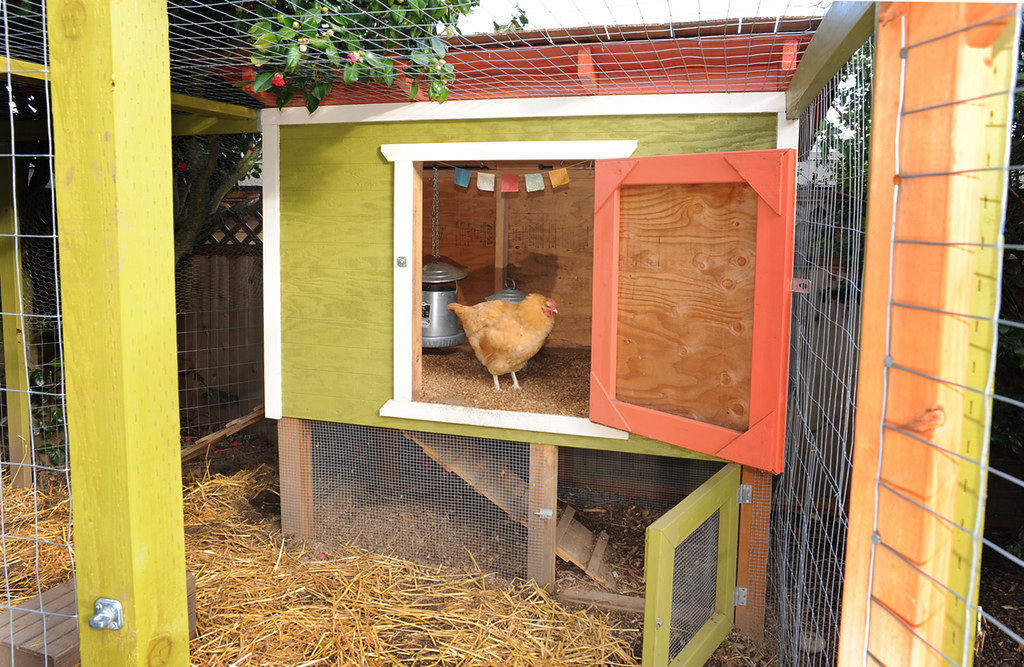
A door that slides down isn’t the same as a door that locks. A raccoon will try to lift a closed door from the bottom with its paws. Look for a self-locking pop door kit or a door the motor holds down firmly. Metal beats plywood here. Aluminum won’t swell and can’t be chewed.
ChickenGuard Opener with Self Locking Door Kit
The same opener packaged with a self-locking door. You get a complete setup in one box instead of matching parts yourself.
What to like
- Self-locking door included
- Timer and light sensor modes
- One box setup
Watch out for
- You need to cut or adapt an opening to fit the kit
- Locking parts should be checked regularly
Paid link. We may earn a commission.
Motors have weight limits. Kerbl rates its controller for doors from 0.5 to 2.5 kg. A heavy homemade door can strain a small motor. Weigh yours before you buy an opener for it.
Size the hole for your biggest bird. The Featherbrain suggests:
- Bantams: 9 inches wide by 9 to 12 inches high
- Standard breeds: 10 inches wide by 10 to 13 inches high
- Large breeds: 12 inches wide by 12 to 14 inches high
Mount the door 6 to 12 inches above the coop floor. Deep litter can reach 12 to 18 inches. Bedding piled against a sliding door is a classic reason it jams. Our predator-proofing guide covers the rest of the coop’s weak spots. Seal any gaps around the new frame with half-inch hardware cloth. UMD Extension recommends no gaps over 1/4 inch where chickens roost to keep snakes out.
Living with one day to day
Count heads for the first week. A door that closes before everyone’s in leaves stragglers in the run all night. If that happens push the closing time a little later.
Keep the track clean. ChickenGuard’s manual advises cleaning the track and motor and checking the batteries or solar panel. Dust, feathers and bedding all collect in the slot.
Make sure there’s a manual override. You’ll want it on the day you need to shut birds in early.
Remember that the pop hole is only one opening. The people door matters just as much. A two-step predator-proof latch is cheap insurance there.
Before you trust the door for real, stand by the coop at dusk and watch it close. Then try to lift it from the bottom with your fingers. If it rises more than a finger’s width, fix that before a raccoon finds it.