Chicken Coop Fans: Solar and Thermostat Ways to Cool a Hot Coop
We earn from qualifying purchases. How we pick.
Our top picks
- Best for off-grid coops that should vent only when hotLewisia 10W Solar Dual Fan with Temperature ControlCheck price on Amazon →
- Best for a simple no-wiring setup on a coop or shedMARBERO Solar Panel Fan KitCheck price on Amazon →
- Best for small coops that need two exhaust pointserifyng Solar Fan with Two 5 Inch FansCheck price on Amazon →
A fan cools a hot coop best when it pulls hot air out and keeps air moving over the birds. Choose the power source first. Go solar if the coop has no outlet. Go with a thermostat fan if it does.
All our picks
Solar fans
- Best for off-grid coops that should vent only when hotLewisia 10W Solar Dual Fan with Temperature ControlA solar dual fan with a built-in temperature control and timer.Check price on Amazon →Details ↓
- Best for a simple no-wiring setup on a coop or shedMARBERO Solar Panel Fan KitA solar fan kit sold for chicken coops and sheds.Check price on Amazon →Details ↓
- Best for small coops that need two exhaust pointserifyng Solar Fan with Two 5 Inch FansTwo 5 inch fans run off one solar panel.Check price on Amazon →Details ↓
Thermostat fans
- Best for turning a fan you already own into a thermostat fanBN-LINK Digital Cooling Thermostat OutletPlug a corded fan into this outlet and it runs only above the temperature you set.Check price on Amazon →Details ↓
- Best for larger coops with powerAC Infinity AIRLIFT T10 Shutter Exhaust FanA 10 inch wall-mount exhaust fan with a temperature and humidity controller.Check price on Amazon →Details ↓
In this guide
Why moving air matters more than cold air
Chickens can’t sweat. They lose heat into the air around their bodies and by panting. Panting is usually the first sign a bird is in trouble. Mississippi State Extension adds drooping wings and pale combs to the list. Lethargy comes after that.
The University of Arkansas poultry extension puts it plainly. High air speed is the most effective tool for managing heat stress. Moving air strips heat off the bird’s body. It also clears away the pocket of warm damp air that builds up around a sitting hen. Commercial broiler houses are built for 600 to 700 feet per minute of air speed. Your backyard coop won’t get close to that. It doesn’t need to. A steady draft through a stuffy coop is a big step up from still air.
Humidity is the hidden problem. Damp air makes panting much less effective. Mississippi State notes that summer night humidity often sits between 80 and 95 percent. So don’t switch the fan off at sunset. Birds recover overnight and moving air helps them do it.
Solar fans for coops without power
Most backyard coops sit a long way from an outlet. A small solar fan kit gets around that with no wiring at all. The panel goes on the roof or on a post in full sun. The fan mounts high on a wall and pushes hot air out.
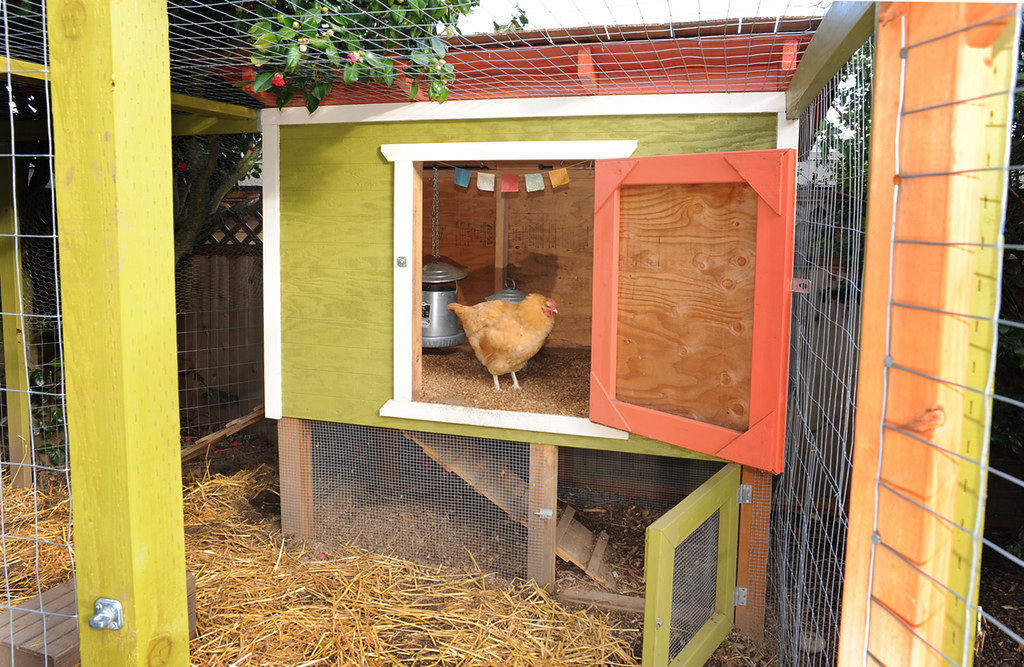
These little fans work as exhaust fans. They pull the hottest air from under the roof so cooler air can flow in through low vents. That only works if you have intake openings. Our guide to chicken coop ventilation covers how much open area you need.
A solar fan with a built-in thermostat is the smarter version. It runs only when the coop gets hot. So on a cool spring day it doesn’t run for nothing.
Lewisia 10W Solar Dual Fan with Temperature Control
A solar dual fan with a built-in temperature control and timer. It switches on when the coop heats up and needs no outlet.
What to like
- Built-in temperature control
- Timer function
- IPX5 weatherproof rating
Watch out for
- Output drops when the sun is low
- More settings to learn than a basic kit
MARBERO Solar Panel Fan Kit
A solar fan kit sold for chicken coops and sheds. You mount the fan and the panel and it runs whenever the sun is out.
What to like
- No wiring or outlet needed
- Made with coops and sheds in mind
- Easy to fit
Watch out for
- No thermostat
- Stops when the panel is shaded
erifyng Solar Fan with Two 5 Inch Fans
Two 5 inch fans run off one solar panel. That suits a small coop where one fan leaves a dead corner.
What to like
- Two fans from one panel
- IPX7 water resistance
- Fits small coops
Watch out for
- Small fans move modest air
- No temperature control
Solar has one honest weak spot. Output peaks at midday and fades in late afternoon. But late afternoon is often when a coop is hottest. Angle the panel toward the west if your site allows it.
Thermostat fans for coops with an outlet
If you can run an outdoor-rated cord to the coop you get more choice. The simplest route is a plug-in cooling thermostat. You plug any corded fan into it and set a temperature. The fan turns on above that number and off below it. The BN-LINK unit covers 40 to 108°F and handles up to 1000 watts.
BN-LINK Digital Cooling Thermostat Outlet
Plug a corded fan into this outlet and it runs only above the temperature you set. It's a budget way to automate cooling.
What to like
- Works with any corded fan up to 1000 watts
- Set range of 40 to 108°F
- ETL listed
Watch out for
- Needs power at the coop
- Keep it dry and out of the rain
A bigger walk-in coop does better with a wall-mount shutter exhaust fan with a controller. Its controller reads temperature and humidity. It speeds the fan up as the coop heats. The shutters close when the fan stops. That keeps rain and winter drafts out.
AC Infinity AIRLIFT T10 Shutter Exhaust Fan
A 10 inch wall-mount exhaust fan with a temperature and humidity controller. It raises its speed as the coop warms up.
What to like
- Responds to both heat and humidity
- 10 speed EC motor
- Shutters close when off
Watch out for
- Needs an outlet
- Larger install than a solar kit
Keep those shutters clean. Mississippi State Extension says dirty shutters can cut airflow by as much as 30 percent. Coop dust is fine and sticky. Wipe the blades and louvers every few weeks in summer.
Not sure where to set the thermostat? Watch your own birds. Note the temperature when they start panting and set the fan a few degrees below that. A small Bluetooth thermometer and hygrometer in the coop shows both numbers on your phone.
What a fan can’t fix
A fan moves air. It can’t cool air that’s already scorching. Texas A&M AgriLife warns that a coop in constant afternoon sun can turn into a furnace. Shade comes first. Plant something or hang a tarp on the west side. If you haven’t built yet, read where to put a chicken coop first.
Go easy on misters. Evaporative cooling lowers air temperature but adds humidity. The University of Arkansas figures relative humidity rises about 2.5 percent for every degree Fahrenheit of cooling. On a muggy day that can leave birds worse off than plain moving air.
Water matters as much as air. Arkansas notes that birds normally drink about twice as much water as they eat in feed. Under heat stress that jumps to 3 or 4 times. Keep drinkers in the shade. On triple-digit days Texas A&M suggests adding ice to the water.
Heat stress also costs you eggs. Mississippi State says laying can take about a month to get back to normal afterward. So fit and test your fan in spring. Run it through one full sunny day in May and check the coop at 4 pm. If it’s still much hotter inside than out you need more intake vents low on the shady side.
Keep reading
Read next: where to put a chicken coop and chicken roosting bars. Or browse the roost and climate gear in the shop.
Sources
- Backyard poultry producers should be wary of high temperatures, Texas A&M AgriLife Today
- Protect backyard chickens and livestock from extreme heat, Mississippi State University Extension
- Prepare Broiler Houses for Summer Weather, Mississippi State University Extension
- Avian Advice July 2026: Managing Heat Stress in Commercial Poultry Operations, University of Arkansas
How we picked
We compare maker specs with owner reviews and expert sources like university extension poultry guides. We look for the problems owners report again and again. Then we keep the products whose specs fit what a small flock needs. These picks come from that research and not from our own hands on trials. Nobody pays for a place in our guides. Read how we choose products.