Chicken Run Size and Fencing
We earn from qualifying Amazon purchases. We haven't tested these products ourselves. We chose them from specs and what chickens need. How we make money.
Most coop losses don’t happen in the coop. They happen in the run. A fox digs under the fence at dawn. A raccoon reaches through chicken wire and grabs a hen roosting too close to it. A hawk drops into an open top run at lunchtime.
Our top picks
Paid links. We earn from qualifying Amazon purchases. We chose these from specs and owner feedback, not our own testing. Photos show the type of gear, not the exact product.
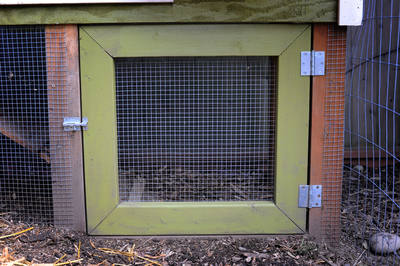 Best wire for the lower run wallsTrenk Hardware Cloth, half inch mesh, 36 in by 50 ftGalvanized welded mesh with half inch holes in 19 gauge wire.Check price on Amazon →Details ↓Photo: furtwangl, CC BY 2.0
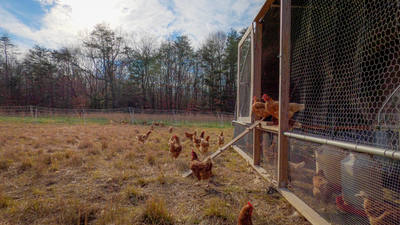 Best for adding run space fastPawHut Galvanized Walk-in Chicken Run with Cover, about 9 by 18 ftA big galvanized steel frame with a waterproof cover.Check price on Amazon →Details ↓Photo: USDA, CC0
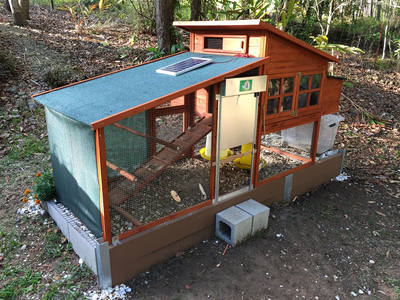 Best for locking up at dusk without failRUN-CHICKEN T50 Automatic Coop DoorIt shuts the pop door at sunset and opens it at sunrise.Check price on Amazon →Details ↓Photo: sridgway, CC BY 2.0
The good news is that every one of those has a simple fix. Get the size right and pick the right wire. Close off the ground and the sky. Here’s how.
In this guide
How big should the run be?
The figure most extension guides use is about 10 square feet of outdoor run per laying hen. That comes from guidelines collected by the Poultry Extension network. It’s a minimum. More room means less bullying and a floor that turns to mud more slowly.
| Flock | Run area | Example size |
|---|---|---|
| 3 hens | about 30 sq ft | 5 by 6 ft |
| 4 hens | about 40 sq ft | 5 by 8 ft |
| 6 hens | about 60 sq ft | 6 by 10 ft |
| 10 hens | about 100 sq ft | 10 by 10 ft |
Bantams can manage with a bit less. Big breeds like Brahmas want more. If your hens never free range then go as big as your yard allows.
Shape matters too. A run about twice as long as it is wide works well in most yards. Make sure you can reach every corner. You will need to rake it and catch a hen in it one day.
Our guide to how much space chickens need shows how run space and coop space work together.
How tall?
You’ll be in that run every week. So build it tall enough to stand in. Six to seven feet of headroom saves your back. Low runs of 3 or 4 feet come with many small kits. The hens don’t mind them. You will.
Chicken wire won’t keep predators out
This is the most important part of the whole article.
Chicken wire is made to keep chickens in. It was never meant to keep predators out. The thin twisted wire is easy for a dog to tear. A raccoon can reach straight through the holes.
For any part of the run a predator can reach use half inch hardware cloth. It’s a stiff welded mesh with small square holes. Paws can’t get through. Rats and weasels can’t squeeze in.
Hardware cloth costs more than chicken wire. Many keepers save money like this:
- Hardware cloth on the bottom 2 to 3 feet of the walls
- Hardware cloth over every window and vent in the coop
- Cheaper 1 by 2 inch welded wire higher up the walls
Trenk Hardware Cloth, half inch mesh, 36 in by 50 ft
Galvanized welded mesh with half inch holes in 19 gauge wire. A 36 inch roll covers the bottom of the walls. There's plenty left for the apron.
What to like
- Holes too small for paws and rats
- Far stronger than chicken wire
- 50 ft covers a small run
Watch out for
- Slow to cut and fit
- Sharp cut edges so wear gloves
Paid link. We may earn a commission.
Stop the diggers
Foxes, dogs and skunks dig. A fence that stops at the grass is an open invitation.
The University of Kentucky’s housing guide gives clear numbers. Bury the wire at least 12 inches deep. Then bend the bottom out about 6 inches away from the run. A digging animal starts at the base of the fence. It hits wire and gives up.
Trenching is hard work in rocky ground. An apron is the easier option. Lay hardware cloth flat on the ground around the outside of the run. Make it about 12 to 24 inches wide. Fix it to the bottom of the wall and cover it with soil or turf. The grass grows through and you’ll soon forget it’s there.
The same guide mentions one more layer. You can run an electric wire about 4 inches off the ground and about a foot outside the fence.
Close the top
Hawks and owls come from above. Raccoons climb. A covered run deals with both.
- Hardware cloth or welded wire on top stops climbers and birds of prey.
- Bird netting stops hawks. It won’t stop a raccoon or a cat.
- A solid roof over part of the run gives shade and keeps rain off the feed.
Can’t cover it all? The Kentucky guide suggests a grid of twine 3 to 4 feet above the pen to put off hawks. A bush inside the run gives hens somewhere to hide.
Buy a run or build one?
Building lets you pick every material. It also takes a few weekends and some tools.
A ready made walk in run is the fast way to get lots of space. Check three things before you trust one. Look at the wire. Look at the cover. Look at how it anchors to the ground.
PawHut Galvanized Walk-in Chicken Run with Cover, about 9 by 18 ft
A big galvanized steel frame with a waterproof cover. At about 9 by 18 feet it gives a small flock well over 10 square feet a bird. Most people set it around a smaller coop.
What to like
- Walk in height for chores
- Steel frame won't rot
- Lots of space quickly
Watch out for
- Stock mesh is light so add hardware cloth low down
- The fabric cover won't stop predators
- Needs anchoring in wind
Paid link. We may earn a commission.
Measure the square footage yourself. Don’t trust a “fits 10 chickens” label.
Doors and latches
Predators test every weak spot. A few small details matter a lot.
- Fix wire to wood with screws and washers. Staples alone pull out.
- Overlap seams by a few inches.
- Use a latch that needs two steps to open. Raccoons can undo a simple hook or slide bolt.
- Check the gap under the door. A rat needs less space than you’d think.
Even a good run is safest with the hens shut in the coop at night. The Kentucky guide recommends locking birds up before dark if the run isn’t fully predator proof. An automatic door means you never forget.
RUN-CHICKEN T50 Automatic Coop Door
It shuts the pop door at sunset and opens it at sunrise. It runs on batteries so you don't need power at the coop.
What to like
- Closes on time every night
- No wiring
- Light sensor or timer
Watch out for
- Watch it close for the first week
- A hen left outside gets locked out
Paid link. We may earn a commission.
There’s more on latches and night raids in our predator proofing guide.
What goes on the floor
Hens strip grass to bare dirt within a few weeks. Extension advice is blunt about it. A run quickly loses its plants and can turn to mud in wet weather. That makes a well drained spot important. Plan the floor from day one.
- Wood chips or leaves stay soft and soak up wet. Rake them over like deep litter.
- Sand drains well and rakes clean. It works best under a roof.
- Gravel under chips helps in a soggy yard.
Leave a dry corner of loose soil or sand for dust baths. Your hens will spend hours in it.
If the run floods every spring the problem may be the spot itself. See where to put a chicken coop.
Quick answers
Is chicken wire ever OK? Yes for a daytime garden fence or as netting on top. Not for the lower walls of a run.
How high should an open top fence be? Five to six feet stops most hens. It won’t stop a climber. A cover is safer.
Can hens live in a run full time? Many do. Give them at least 10 square feet each plus shade and a dust bath.